
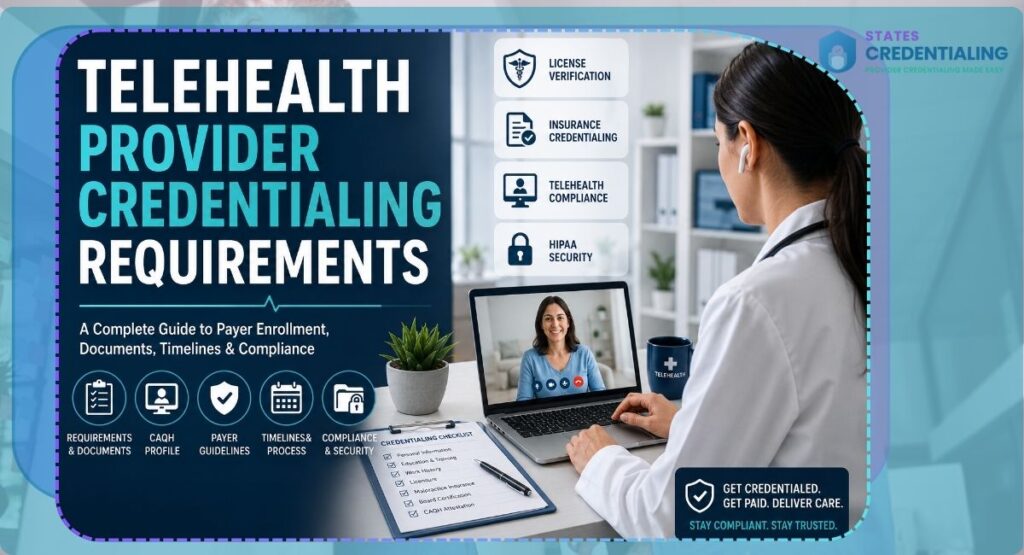
Telehealth has shifted from being an optional service model to a standard part of healthcare delivery. As more providers expand into virtual care, the administrative side of setting up a compliant practice becomes more detailed, especially when it comes to telehealth provider credentialing.
Credentialing is not just paperwork. It is the formal process that allows healthcare professionals to get verified by insurance companies, hospitals, and payer networks so they can legally and financially bill for services. Without it, even highly qualified providers may not receive reimbursement for telehealth consultations.
For many clinics and independent practitioners, the process becomes complex due to differing payer rules, state-level licensing variations, and documentation requirements. This guide is designed as a practical manual for understanding telehealth credentialing requirements, step-by-step enrollment procedures, documentation standards, and operational practices that reduce delays.
For providers looking to streamline onboarding and enrollment, structured support such as Provider Credentialing Services helps reduce administrative delays and improves approval consistency across payers.
Understanding Telehealth Provider Credentialing in Simple Terms
Telehealth provider credentialing is the verification process that confirms a provider’s qualifications, licenses, work history, malpractice coverage, and training before allowing them to deliver and bill virtual care services.
It applies to:
- Physicians offering virtual consultations
- Nurse practitioners and physician assistants
- Behavioral health providers using video or audio-based care
- Specialty clinicians working through telemedicine platforms
Credentialing ensures that providers meet payer requirements before they are added to insurance networks.
Unlike basic enrollment, credentialing focuses on verifying identity, professional background, and clinical eligibility. After credentialing, providers undergo payer enrollment, which allows them to bill insurance plans.
A related topic often confused with credentialing is explained in detail in this resource on provider enrollment vs credentialing, which helps clarify how both processes work together but serve different purposes.
Why Telehealth Credentialing Has Unique Requirements
Traditional in-person credentialing and telehealth credentialing overlap, but telehealth adds additional layers of verification.
These include:
- Verification of multi-state licensure for cross-border consultations
- Confirmation of telehealth service eligibility for each payer
- Platform compliance with HIPAA and data security standards
- Additional documentation of virtual care workflows
Insurance companies often evaluate telehealth providers more strictly due to the nature of remote care delivery. The absence of physical interaction increases the importance of documentation accuracy and compliance alignment.
Providers expanding into telehealth must also understand that reimbursement policies vary significantly between commercial insurers, Medicare, and Medicaid programs.
For example, Medicare has specific rules regarding originating sites, eligible services, and provider types. A detailed breakdown is available in the Medicare provider enrollment process guide.
Core Telehealth Provider Credentialing Requirements
Credentialing requirements are consistent in structure but vary slightly depending on payer type and state regulations. The following table outlines the core requirements most telehealth providers must prepare.
Core Credentialing Requirements for Telehealth Providers
| Requirement Category | Details | Purpose |
| Medical License | Active state license in each practicing state | Confirms legal authority to practice |
| DEA Registration | Required for prescribing controlled substances (if applicable) | Validates prescribing authority |
| Board Certification | Specialty certification (if applicable) | Confirms clinical expertise |
| NPI Number | National Provider Identifier (Type 1 and Type 2 if group) | Identifies provider in billing systems |
| Malpractice Insurance | Active coverage with required limits | Protects provider and payer |
| Work History | 5–10 years of employment history | Validates experience and continuity |
| Education Records | Medical school, residency, fellowship | Confirms qualifications |
| CAQH Profile | Updated credentialing profile | Centralized data submission |
| Telehealth Platform Compliance | HIPAA-compliant system documentation | Ensures secure virtual care delivery |
Many providers struggle most with maintaining consistent documentation across multiple payers. A structured approach such as insurance credentialing services, helps maintain accuracy across applications and reduces rework.
Step-by-Step Telehealth Credentialing Process
The credentialing process follows a structured sequence. While each payer has its own system, the overall workflow remains consistent.
Step 1: Initial Data Collection
Providers must gather all personal, educational, and professional records before beginning applications. Missing documents often cause delays at later stages.
Key items include:
- Updated CV with no gaps in employment
- State license copies
- Board certification documents
- Malpractice insurance certificates
- Identification documents
This stage often determines the speed of the entire process.
Step 2: CAQH Profile Setup
Most insurance companies use CAQH ProView as a centralized database for credentialing data.
Providers must:
- Create or update CAQH profiles
- Upload required documentation
- Re-attest information every 120 days
Proper completion of CAQH is essential. Errors or outdated entries often lead to application rejection.
A deeper breakdown is available in CAQH credentialing requirements which explains how to maintain accuracy and avoid rejections.
Step 3: Application Submission to Insurance Panels
Once CAQH is complete, providers apply to insurance networks individually or through delegated credentialing systems.
Applications include:
- Credentialing forms
- Tax identification details
- Practice location information
- Telehealth service scope
Each payer has different processing timelines.
Step 4: Verification Process
Insurance companies verify:
- Licensing status
- Education credentials
- Malpractice history
- Work experience
- Sanctions or disciplinary records
This stage often involves primary source verification, where institutions are contacted directly.
Step 5: Committee Review
After verification, credentialing committees review applications. They evaluate:
- Provider eligibility
- Network needs
- Compliance with payer standards
Approval or rejection decisions are made at this stage.
Step 6: Contracting and Network Enrollment
Once approved, providers receive contracts outlining:
- Reimbursement rates
- Billing rules
- Telehealth service conditions
After signing, providers are officially added to insurance networks.
Documentation Checklist for Telehealth Credentialing
Documentation accuracy plays a major role in approval timelines.
Credentialing Document Checklist
| Document Type | Description | Common Issues |
| CV/Resume | Full professional history | Employment gaps not explained |
| State License | Active and unrestricted | Expired licenses |
| DEA Certificate | If prescribing medications | Incorrect address |
| Malpractice Insurance | Coverage proof | Lapsed policy |
| Board Certification | Specialty verification | Missing renewals |
| Identification | Government-issued ID | Name mismatch |
| Tax Information | W-9 or EIN details | Incorrect tax ID |
| CAQH Attestation | Updated every 120 days | Outdated attestation |
| Telehealth Compliance Docs | HIPAA compliance proof | Missing platform certification |
For providers looking to avoid administrative gaps, structured insurance verification systems help ensure payer-ready documentation before submission.
Telehealth Credentialing Requirements by Payer Type
Different payer categories apply different rules for telehealth providers.
Medicare Requirements
Medicare has specific telehealth eligibility rules:
- Providers must be enrolled in Medicare
- Services must be eligible for telehealth reimbursement
- Documentation must support medical necessity
Medicare enrollment is often more structured and slower compared to commercial payers.
Medicaid Requirements
Medicaid varies by state:
- Some states allow full telehealth parity
- Others restrict eligible services
- Provider enrollment is state-specific
Telehealth providers must check each state Medicaid policy individually.
Commercial Insurance Requirements
Commercial payers like Blue Cross, Aetna, and UnitedHealthcare typically require:
- CAQH profile completion
- Credentialing committee approval
- Telehealth platform compliance documentation
Approval timelines vary widely depending on network demand.
Common Telehealth Credentialing Challenges
Credentialing delays often occur due to preventable issues.
Common Issues and Their Impact
| Challenge | Cause | Impact |
| Missing documents | Incomplete preparation | Application rejection |
| CAQH errors | Incorrect data entry | Processing delays |
| License mismatch | Wrong state details | Application hold |
| Malpractice gaps | Lapsed coverage | Denial |
| Employment gaps | Unexplained timeline gaps | Additional verification |
| Payer backlog | High application volume | Extended wait time |
A detailed discussion on error prevention is available in the credentialing checklist for providers which helps practices avoid common documentation mistakes.
Timeline Expectations for Telehealth Credentialing
Credentialing is not immediate. Timelines depend on payer type and application accuracy.
Average Credentialing Timelines
| Payer Type | Average Time | Notes |
| Medicare | 60–120 days | Strict verification |
| Medicaid | 45–90 days | State dependent |
| Commercial Insurance | 60–180 days | Varies widely |
| CAQH Processing | 1–2 weeks | Depends on attestation |
| Hospital Privileging | 30–60 days | If applicable |
More detailed insights are available in insurance credentialing timeline for physicians which breaks down delays by payer behavior and application type.
Compliance Requirements in Telehealth Credentialing
Telehealth providers must comply with multiple regulatory frameworks:
- HIPAA compliance for patient data protection
- State telemedicine practice laws
- Insurance billing compliance standards
- Documentation retention policies
HIPAA compliance is especially important due to digital communication risks. Telehealth platforms must demonstrate encryption, secure storage, and controlled access systems.
Providers are also expected to maintain audit-ready documentation practices. A useful reference is this external guide on audit preparedness:
5 Audit-Ready Practices to Stay Ahead of Payers
Operational Best Practices for Telehealth Credentialing
Efficient credentialing requires structured workflows.
Key practices include:
- Maintaining a centralized document repository
- Updating CAQH every 120 days without delay
- Tracking license renewals in advance
- Assigning credentialing responsibilities clearly
- Monitoring payer communication regularly
Many practices also integrate credentialing with revenue cycle management systems to reduce delays between approval and billing readiness.
Outsourcing vs In-House Credentialing for Telehealth Providers
Telehealth practices often debate whether to manage credentialing internally or outsource it.
In-house credentialing:
- Requires trained administrative staff
- Works well for small provider groups
- Higher risk of delays during staff turnover
Outsourced credentialing:
- Managed by specialized teams
- Faster payer communication handling
- Better tracking of deadlines and renewals
Providers seeking structured support often rely on provider credentialing solutions to manage end-to-end enrollment workflows.
Outsourcing is especially helpful for multi-state telehealth providers dealing with different payer systems simultaneously.
How Credentialing Impacts Telehealth Revenue
Credentialing directly affects revenue flow. Without proper enrollment:
- Claims are denied
- Services cannot be billed
- Revenue cycles stall
Even a short delay in credentialing can affect months of revenue collection. This is why accurate documentation and early submission are important.
A broader discussion on billing impact is available here:
Why Billing Accuracy Matters for Patient Retention
Telehealth Credentialing Mistakes to Avoid
Common errors include:
- Submitting incomplete applications
- Ignoring CAQH attestation deadlines
- Using outdated malpractice certificates
- Not tracking payer follow-ups
- Missing state-specific telehealth rules
Each of these errors increases approval time and may result in rejection.
Relationship Between Credentialing and Recredentialing
Credentialing is not a one-time process. Providers must undergo recredentialing periodically, usually every 2–3 years.
Recredentialing ensures:
- Continued compliance
- Updated licensing
- Verified clinical performance
More details are covered in recredentialing services which explains ongoing compliance requirements for providers.
Internal Systems That Support Credentialing Accuracy
Modern telehealth practices often connect credentialing with:
- Electronic Health Records (EHR)
- Practice management systems
- Billing platforms
This reduces manual errors and improves consistency in provider data across systems.
A related technical insight can be found in this guide:
Why EHR Integration Is Key to Better Billing
Final Thoughts on Telehealth Provider Credentialing
Telehealth provider credentialing is a structured process that determines whether a provider can legally and financially deliver virtual care services. It involves documentation accuracy, payer-specific compliance, CAQH management, and continuous monitoring of renewals and licensing.
Providers who manage these steps systematically reduce delays and improve payer acceptance rates. Those handling multi-state or high-volume telehealth services often benefit from structured credentialing support systems that maintain consistency across applications.
For practices looking to build a stable enrollment process and reduce administrative delays, States Credentialing offers structured solutions for provider enrollment, payer credentialing, and ongoing revalidation support tailored for modern telehealth operations.