
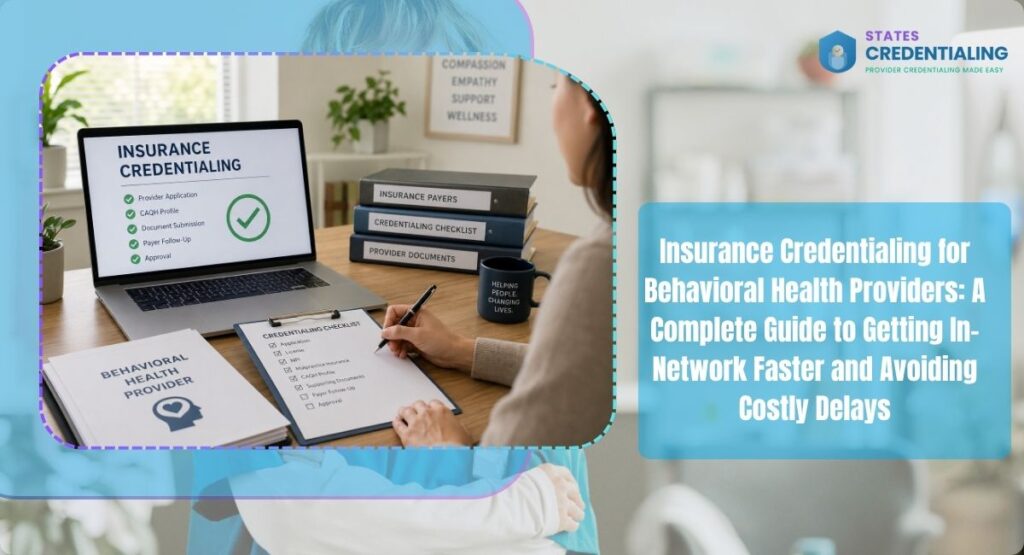
Why Credentialing Feels Like the Hardest Part of Starting a Practice
Many behavioral health providers enter private practice with a clear goal in mind, helping clients access consistent mental health care. But almost immediately, they run into a major roadblock that has nothing to do with clinical skills: insurance credentialing.
The process of getting approved by insurance companies is slow, paperwork heavy, and often confusing. Therapists, counselors, psychologists, psychiatrists, and clinical social workers frequently wait months before they can accept insurance payments. During this time, sessions may be limited to out-of-pocket payments, which reduces patient access and creates financial pressure on the practice.
This is where behavioral health credentialing becomes essential. It is the gateway to joining insurance panels, getting reimbursed by payers, and building a stable, long-term practice.
The challenge is not just submitting forms. It is understanding payer expectations, managing multiple applications, maintaining accurate provider data, and avoiding mistakes that lead to delays or rejections.
This guide breaks down the entire insurance credentialing process for behavioral health providers in a practical way. It explains what is required, why delays happen, and how to move through the system efficiently so you can start billing insurance with confidence.
What is Behavioral Health Credentialing and Why It Matters
Behavioral health credentialing is the process of verifying a provider’s qualifications and enrolling them with insurance companies so they can become in-network providers.
Insurance companies do not automatically accept every licensed clinician. Instead, they review education, licensing, work history, malpractice insurance, and background checks before granting participation in their network.
For behavioral health providers, this process is especially important because most patients rely on insurance coverage for ongoing therapy and psychiatric care.
Credentialing typically involves three major components:
- Provider verification (education, license, board certification)
- Insurance panel enrollment
- Contracting and approval for reimbursement
Without completing this process, providers cannot legally bill insurance companies for services, even if the patient has coverage.
This is why many practices rely on structured systems such as Insurance Credentialing Services to streamline approvals and reduce administrative delays.
Behavioral health credentialing is not a one-time task. It is an ongoing compliance requirement that ensures providers remain active within insurance networks.
Why Behavioral Health Credentialing Is More Complex Than Other Specialties
Compared to many other healthcare fields, behavioral health credentialing has unique challenges that slow down approval timelines.
One major reason is the high demand for mental health services combined with strict payer scrutiny. Insurance companies are careful about maintaining network quality while managing high patient utilization rates.
Another complexity is the variety of provider types involved. Behavioral health includes:
- Psychiatrists (MD, DO)
- Psychologists (PhD, PsyD)
- Licensed Clinical Social Workers (LCSW)
- Licensed Professional Counselors (LPC)
- Marriage and Family Therapists (LMFT)
Each provider type has different licensing requirements, supervision history, and scope of practice, which makes verification more detailed.
Additionally, behavioral health services often involve recurring sessions, telehealth platforms, and group therapy models. This increases payer risk assessment and documentation requirements.
Another factor is fragmented payer systems. Providers must enroll separately with each insurance company, Medicaid programs, and managed care organizations (MCOs), each with different forms and timelines.
Many providers also underestimate the importance of standardized profiles like CAQH. Missing or inconsistent data across applications is one of the top reasons for delays in behavioral health credentialing.
Step-by-Step Insurance Credentialing Process for Behavioral Health Providers
Understanding the credentialing workflow helps reduce confusion and prevents costly mistakes. While each insurance company has its own process, the general structure remains similar.
Step 1: Obtain National Provider Identifier (NPI)
The NPI is a unique identification number required for all healthcare providers in the United States. It is used in billing, credentialing, and insurance enrollment.
There are two types:
- Type 1 NPI for individual providers
- Type 2 NPI for group practices
You can apply through the NPPES system, which is managed by CMS.
Step 2: Set Up CAQH Profile
The Council for Affordable Quality Healthcare (CAQH) ProView is a centralized database used by most insurance companies.
Providers submit their credentials once, and payers access the same profile instead of requesting repeated paperwork.
A complete profile includes:
- Education history
- License details
- Work experience
- Malpractice insurance
- References
Many providers struggle at this stage, which is why structured assistance like CAQH Credentialing helps ensure accuracy and faster approval.
Step 3: Apply to Insurance Panels
After CAQH is complete, providers apply directly to insurance companies such as:
- Blue Cross Blue Shield
- Aetna
- Cigna
- UnitedHealthcare
- Medicaid managed care plans
Each payer requires a separate application.
Step 4: Verification and Background Checks
Insurance companies verify:
- Licenses
- Board certifications
- Work history
- Malpractice coverage
- Sanctions or disciplinary actions
Any inconsistencies can delay approval significantly.
Step 5: Credentialing Committee Review
Once verification is complete, the application is reviewed by a credentialing committee. They decide whether the provider meets network standards.
Step 6: Contracting and Network Participation
If approved, the provider receives a contract outlining reimbursement rates, billing rules, and participation requirements.
At this stage, providers officially become in-network and can begin billing insurance.
The Role of CAQH in Behavioral Health Credentialing
CAQH is one of the most critical components in modern credentialing workflows. Without it, insurance enrollment becomes significantly slower.
Instead of submitting documents repeatedly, providers maintain a single digital profile that is shared across multiple payers.
However, CAQH requires quarterly attestation. This means providers must regularly confirm that their information is still accurate.
Common CAQH issues include:
- Expired malpractice insurance
- Missing work history updates
- Incorrect practice addresses
- Incomplete license information
These small errors can lead to major delays in insurance credentialing.
Providers often combine CAQH management with broader Provider Credentialing Services to maintain accuracy and avoid interruptions.
Common Mistakes That Delay Behavioral Health Credentialing
Even experienced providers face delays due to avoidable errors. Understanding these mistakes can significantly improve approval speed.
1. Incomplete Applications
Missing fields or unsigned forms are one of the most common issues. Insurance companies reject incomplete submissions immediately.
2. Inconsistent Information
If CAQH data does not match insurance applications, verification fails. Even small differences in addresses or employment dates can trigger delays.
3. Expired Documentation
Licenses, malpractice insurance, and certifications must always be current.
4. Poor Tracking of Applications
Providers often apply to multiple payers but fail to track status updates, leading to missed requests for additional information.
5. Ignoring Recredentialing Requirements
Credentialing is not permanent. Providers must undergo periodic recredentialing to remain active in insurance networks.
More details on this lifecycle are explained in Provider Enrollment vs Credentialing which helps clarify how enrollment and credentialing differ in practice.
Behavioral Health Credentialing Timeline: What to Expect
One of the most common questions providers ask is how long credentialing takes.
The timeline varies depending on payer workload, application accuracy, and specialty type.
On average:
- Medicaid enrollment: 30 to 90 days
- Commercial insurance: 60 to 120 days
- Medicare enrollment: 60 to 180 days
Delays often occur due to missing documentation or verification bottlenecks.
A deeper breakdown is available in Insurance Credentialing Timeline for Physicians which explains payer-specific delays and expectations.
Behavioral health providers sometimes experience slightly longer timelines due to higher demand and stricter network controls.
Insurance Requirements for Behavioral Health Providers
Insurance companies require detailed documentation before approving behavioral health providers.
Key requirements include:
- Active state license
- DEA registration (for prescribing providers)
- Malpractice insurance certificate
- Education and training records
- Work history verification
- Board certification (for psychiatrists)
In addition, some payers require supervision documentation for associate-level clinicians.
Managed care organizations (MCOs) may also request additional utilization data to evaluate network need.
Insurance companies are particularly strict about accuracy because behavioral health services often involve ongoing treatment plans and recurring claims.
How to Streamline Behavioral Health Credentialing
Speeding up credentialing requires structure and consistency.
Here are proven strategies used by successful practices:
Maintain a Centralized Document System
Keep all licensing, insurance, and work history documents in one secure system. This reduces errors during application submission.
Use Standardized Data Across All Applications
Ensure CAQH, NPI, and payer applications all match exactly.
Track Every Application
Use spreadsheets or credentialing software to monitor submission dates, follow-ups, and approvals.
Respond Quickly to Payer Requests
Insurance companies often request additional information. Delays in response can extend credentialing by weeks.
Work with Credentialing Specialists
Many providers choose outsourcing to reduce administrative burden and speed up approvals.
This is where services like Insurance Credentialing Services become valuable for behavioral health practices managing multiple payers.
Why Outsourcing Credentialing Makes Sense for Behavioral Health Practices
Behavioral health practices often operate with limited administrative staff. Managing credentialing internally can quickly become overwhelming.
Outsourcing helps by:
- Reducing administrative workload
- Improving accuracy of applications
- Speeding up payer approvals
- Preventing costly mistakes
- Ensuring ongoing compliance
It also allows providers to focus more on patient care rather than paperwork.
Credentialing specialists are familiar with payer systems, which helps reduce rejection rates and improve approval speed.
Recredentialing: The Often Ignored Requirement
Many providers assume credentialing is a one-time process. In reality, insurance companies require periodic recredentialing.
This process typically occurs every 2 to 3 years and involves:
- Updated license verification
- Malpractice insurance renewal
- CAQH re-attestation
- Updated work history
Failure to complete recredentialing can result in termination from insurance networks.
This is why ongoing support such as Recredentialing Services is essential for long-term practice stability.
Real-World Scenario: A Behavioral Health Practice Credentialing Journey
Consider a small group therapy practice starting with three licensed clinicians.
They begin by applying to major insurance payers independently. Each provider submits separate applications, but inconsistencies in CAQH profiles lead to repeated delays.
One clinician forgets to update malpractice insurance. Another has mismatched employment dates across applications. As a result, approvals take nearly five months instead of the expected two to three.
After switching to a structured credentialing system, the practice standardizes documentation, aligns CAQH profiles, and tracks payer submissions.
Within weeks, approval rates improve significantly, and insurance reimbursements begin flowing consistently.
This scenario is common in behavioral health practices that initially underestimate the complexity of credentialing.
Best Practices for Long-Term Credentialing Success
To maintain smooth insurance participation, behavioral health providers should:
- Regularly update CAQH profiles
- Track expiration dates of licenses and insurance
- Maintain consistent documentation across systems
- Monitor payer communication closely
- Plan recredentialing well in advance
Credentialing is not just administrative work. It directly impacts revenue, patient access, and practice growth.
Building a Faster Path to Insurance Participation
Behavioral health credentialing is one of the most important steps in building a sustainable mental health practice. While the process can feel slow and complex, it becomes manageable when approached systematically.
From CAQH setup to payer enrollment and recredentialing, each stage plays a critical role in ensuring providers can deliver care without financial interruptions.
The key is accuracy, consistency, and ongoing maintenance. Small errors can lead to long delays, while structured workflows can significantly shorten approval timelines.
For providers looking to simplify the process and reduce administrative burden, professional support can make a measurable difference.
States Credentialing provides end-to-end support for behavioral health credentialing, CAQH management, and payer enrollment, helping practices get credentialed faster and stay compliant over time.
Learn more at Insurance Credentialing Services and streamline your practice setup with confidence.