
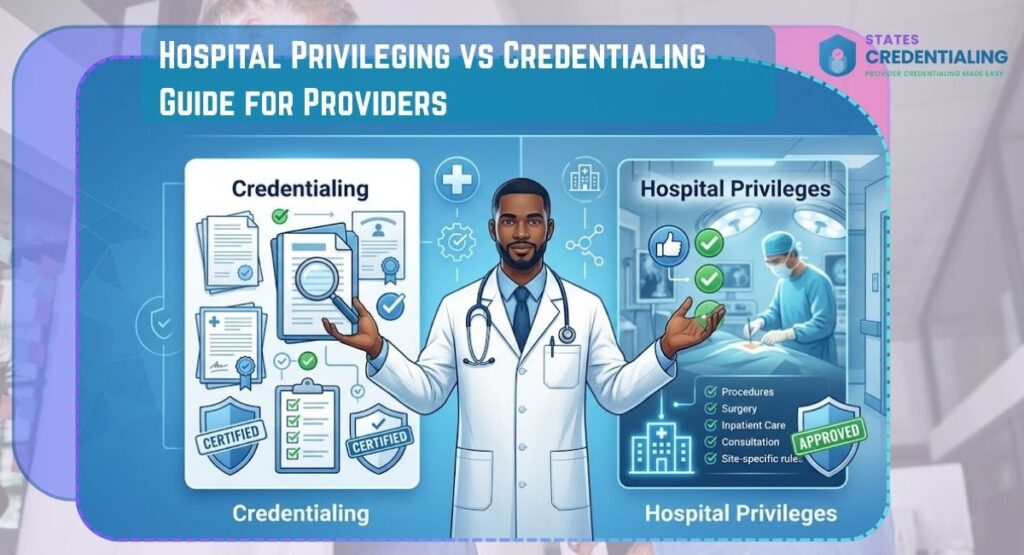
When healthcare providers begin working with hospitals, insurance networks, or group practices, two terms come up repeatedly: credentialing and hospital privileging. These processes shape whether a provider can legally practice, treat patients, and receive reimbursement. Yet many providers entering the system for the first time do not fully understand how they differ or how they work together.
A clear understanding of hospital privileging vs credentialing helps prevent delays, reduces compliance risks, and improves financial stability. If you are starting out or expanding your practice, reviewing a detailed provider credentialing guide early helps you understand how verification impacts payer approvals and onboarding timelines.
This guide explains both processes in depth, compares them, and provides practical steps to manage them effectively.
What Is Provider Credentialing?
Credentialing is the formal process of verifying a healthcare provider’s qualifications. It ensures that physicians, nurse practitioners, and specialists meet professional standards required to deliver care safely.
Credentialing is required for:
- Insurance network participation
- Medicare and Medicaid enrollment
- Hospital employment
- Group practice affiliation
Without credentialing, providers cannot bill insurance companies or operate as in-network providers.
What Gets Verified During Credentialing
- Medical education and training
- State licensure
- Board certifications
- Work history
- Malpractice insurance
- Sanctions and disciplinary records
Credentialing focuses on validating professional background. It answers whether a provider is qualified to practice.
Many practices rely on structured solutions like provider credentialing services to manage applications, documentation, and payer communication efficiently.
What Is Hospital Privileging?
Hospital privileging is the process through which a hospital grants permission to a provider to perform specific clinical procedures within its facility.
While credentialing verifies qualifications, privileging evaluates what a provider is capable of doing in a clinical setting.
What Hospitals Evaluate
- Procedure-specific training
- Clinical experience and case logs
- Peer references
- Patient outcomes
- Specialty expertise
A provider may be credentialed but still restricted from performing certain procedures unless privileges are granted.
Hospital Privileging vs Credentialing: Key Differences
Understanding hospital privileging vs credentialing becomes clearer when comparing their purpose and outcomes.
| Category | Credentialing | Hospital Privileging |
| Purpose | Verify qualifications | Approve clinical procedures |
| Focus | Education and background | Clinical competence |
| Managed By | Insurance companies and credentialing bodies | Hospital committees |
| Outcome | Provider can bill insurers | Provider can perform procedures |
| Renewal | Every 2 to 3 years | Ongoing monitoring |
Credentialing confirms eligibility. Privileging defines scope of practice.
Why Both Processes Matter
These processes are often misunderstood as interchangeable, but they serve entirely different roles.
Without Credentialing
- Claims cannot be submitted
- Insurance reimbursements are denied
- Provider cannot join networks
Without Privileging
- Procedures cannot be performed
- Hospital access is restricted
- Clinical services are limited
Both must be completed for full operational capability.
Delays in credentialing alone can impact finances significantly. Reviewing insights like how physician credentialing delays affect practice revenue highlights the real financial consequences of slow approvals.
Step by Step Credentialing Process
Credentialing follows a structured process designed to verify every aspect of a provider’s professional history.
Credentialing Workflow
- Application submission
- Document collection
- Primary source verification
- Payer review
- Approval and enrollment
Common Documents Required
- Medical license
- DEA registration
- Board certification
- Curriculum vitae
- Malpractice insurance
Using a detailed documents required for provider credentialing checklist helps prevent delays caused by missing or incorrect information.
Step by Step Hospital Privileging Process
Hospital privileging involves deeper evaluation of clinical skills and experience.
Privileging Workflow
- Application submission
- Training and certification review
- Case log evaluation
- Peer reference verification
- Committee approval
Hospitals may grant:
- Temporary privileges
- Full privileges
- Restricted privileges
Many providers streamline this process with support from hospital privileging services to ensure applications meet hospital-specific requirements.
Timeline Comparison
Credentialing and privileging timelines vary but often overlap.
| Process | Average Timeframe | Delay Factors |
| Credentialing | 60 to 120 days | Missing documents, payer backlog |
| Privileging | 90 to 180 days | Committee schedules, case reviews |
| Combined | 3 to 6 months | Coordination gaps |
Understanding the insurance credentialing timeline for physicians helps practices plan onboarding more accurately.
Common Challenges in Credentialing
Credentialing delays are often caused by administrative issues rather than complex requirements.
Frequent Problems
- Incomplete applications
- Outdated documentation
- Errors in CAQH profiles
- Delayed payer responses
Maintaining accurate provider data through CAQH credentialing services ensures insurers can access updated information without repeated submissions.
Common Challenges in Hospital Privileging
Privileging issues typically arise from incomplete clinical documentation.
Frequent Issues
- Insufficient case logs
- Missing peer recommendations
- Incomplete procedure history
- Delayed committee reviews
Hospitals prioritize patient safety, so every detail must be verified before privileges are granted.
Compliance and Regulatory Considerations
Credentialing and privileging are closely tied to healthcare compliance standards.
Organizations must follow:
- State licensing laws
- Accreditation requirements
- Federal healthcare regulations
- Insurance payer policies
Failure to comply can lead to:
- Claim denials
- Legal penalties
- Loss of privileges
Practices often refer to resources like audit ready practices to stay ahead of payers to maintain compliance and avoid operational disruptions.
Recredentialing and Continuous Monitoring
Credentialing is not a one-time process. Providers must undergo periodic recredentialing.
Recredentialing Overview
- Occurs every 2 to 3 years
- Includes updated verification
- Reviews provider performance
Hospitals also monitor ongoing performance to maintain privileges.
Using structured support like recredentialing services helps practices stay compliant and avoid lapses.
Impact on Revenue Cycle
Credentialing and privileging directly affect financial performance.
Revenue Impact
- Delayed credentialing delays billing
- Missing privileges limit procedures
- Incorrect data leads to denials
- Incomplete enrollment affects contracts
Efficient processes result in:
- Faster onboarding
- Consistent revenue flow
- Reduced denials
Many practices align credentialing with strategies like end to end RCM solutions to improve medical practice revenue to strengthen financial outcomes.
When Providers Need Both Processes
Certain situations require credentialing and privileging simultaneously.
Common Scenarios
- Joining a hospital system
- Starting a new practice
- Expanding into new specialties
- Adding advanced procedures
In these cases, coordination is critical. Delays in one process can slow down the other.
Tips to Streamline Credentialing and Privileging
Efficient management requires organization and proactive planning.
Practical Tips
- Keep documents updated
- Track application progress
- Maintain accurate CAQH data
- Start early
- Use expert support when needed
Many practices review why medical practices outsource credentialing services to understand how outsourcing reduces workload and improves turnaround time.
Role of Technology in Credentialing
Technology continues to improve how credentialing and privileging are managed.
Benefits of Automation
- Faster verification
- Centralized data storage
- Reduced errors
- Real-time tracking
Integration with billing systems also enhances efficiency.
Real World Example
A physician joining a hospital may complete credentialing within 90 days but wait an additional 60 days for privileging approval. During this period, the provider cannot perform procedures despite being credentialed.
This delay impacts both patient care and revenue generation.
Choosing the Right Support
Managing credentialing and privileging internally can be time-consuming and complex.
Many practices rely on:
- insurance credentialing services for payer enrollment
- provider credentialing services for verification
- hospital privileging services for clinical approvals
The right approach depends on your practice size, specialty, and administrative resources.
Final Thoughts on Hospital Privileging vs Credentialing
Understanding hospital privileging vs credentialing is essential for providers who want to operate efficiently and remain compliant.
Credentialing verifies qualifications and allows participation in insurance networks. Hospital privileging defines what clinical procedures a provider is authorized to perform. Both are necessary for full practice functionality.
Managing these processes effectively reduces delays, improves revenue flow, and ensures uninterrupted patient care.
If you are onboarding new providers or expanding your practice, working with experienced professionals like States Credentialing can simplify the process. Their expertise in credentialing, recredentialing, and hospital privileging helps providers stay compliant and operational without unnecessary delays.
Helpful Resources