Healthcare providers in the United States cannot simply start seeing patients and billing insurance companies. Before a physician, therapist, or specialist becomes eligible to participate in insurance networks, hospitals, and healthcare systems, they must pass through the provider credentialing process. This process verifies qualifications, training, licensing, and professional history. It also ensures that healthcare professionals meet the standards required by insurance payers and regulatory bodies.
For many providers and practice managers, the most confusing part of this process is understanding the documents needed for provider credentialing. Missing paperwork or incorrect information can delay approvals for weeks or even months. Because credentialing is connected to insurance enrollment and revenue cycle operations, delays can directly affect a practice’s financial performance.
A clear understanding of the required documentation helps providers prepare early, avoid rework, and reduce approval timelines. Many practices also rely on structured credentialing workflows or professional support such as insurance credentialing services, to keep documentation organized and ready for payer review.
This guide explains every major document used in U.S. provider credentialing, how each document is verified, why it matters, and how providers can maintain a credentialing file that remains ready for audits, recredentialing cycles, and insurance enrollment.
Understanding the Purpose of Provider Credentialing Documentation
Provider credentialing documentation exists to verify that healthcare professionals meet clinical, ethical, and legal standards. Payers, hospitals, and regulatory bodies rely on these documents to confirm that a provider is qualified to deliver medical care and bill for services.
Credentialing documentation is used for several types of verification.
- Education and training validation
- Professional licensure verification
- Board certification confirmation
- Work history review
- Malpractice history checks
- Identity and tax identification validation
Insurance companies, hospitals, and government programs such as Medicare and Medicaid use these documents to evaluate whether a provider should be included in their network.
Credentialing documentation is also important for regulatory compliance. Healthcare organizations must maintain credentialing records to comply with national accreditation bodies, state medical boards, and federal healthcare programs.
For example, many credentialing applications require information submitted through the Council for Affordable Quality Healthcare database. Providers often maintain this documentation using tools like CAQH credentialing services, which centralize provider data for multiple insurance payers.
Without complete documentation, credentialing teams cannot verify qualifications. That is why healthcare organizations maintain a standardized list of documents needed for provider credentialing.
Categories of Documents Required for Provider Credentialing
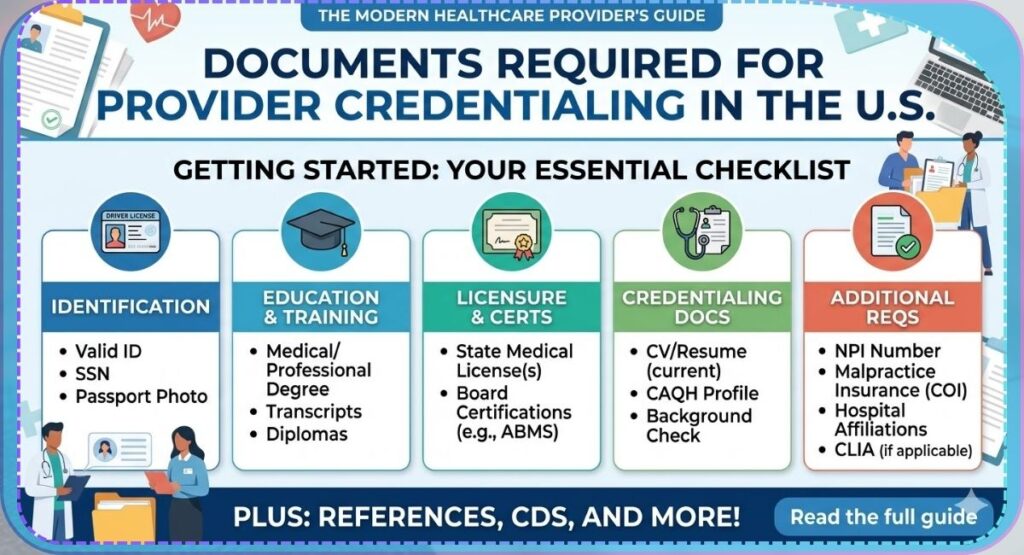
The documents required during credentialing can be grouped into several categories. Each category represents a specific aspect of the provider’s professional background.
Below is a high-level overview of these document groups.
| Credentialing Category | Purpose | Examples |
| Personal Identification | Confirms provider identity | Government ID, Social Security Number |
| Professional Licensing | Verifies legal authority to practice | State medical license |
| Education and Training | Confirms academic qualifications | Medical degree, residency certificate |
| Board Certification | Verifies specialty expertise | Specialty board certificate |
| Practice Information | Identifies practice location | Practice address and contact information |
| Liability Coverage | Confirms malpractice protection | Malpractice insurance certificate |
| Professional History | Reviews employment background | CV, work history records |
| Regulatory Identifiers | Validates payer enrollment | NPI number, DEA registration |
Each category contains several documents that credentialing committees review in detail.
Core Personal Identification Documents
The credentialing process begins with documents that confirm the identity of the healthcare provider. These documents ensure that the individual submitting the application matches the official records held by regulatory authorities.
The most commonly required personal identification documents include the following.
Government Issued Identification
Providers must submit a valid government issued identification document. This can include:
- Passport
- Driver’s license
- State identification card
The purpose of this document is to verify the provider’s legal identity and date of birth.
Credentialing committees also compare the name on the identification document with the name used on medical licenses, education records, and certifications.
Social Security Number Verification
The Social Security Number is often required during credentialing because insurance companies and federal healthcare programs use it to verify identity and tax reporting.
Providers usually submit the SSN through credentialing applications rather than sending the physical Social Security card.
Date of Birth and Legal Name Documentation
Credentialing files must contain accurate records of the provider’s legal name and date of birth.
If the provider has changed their name due to marriage or other legal reasons, documentation such as a marriage certificate or court order may be required.
These identity documents serve as the foundation for all other credentialing verification.
Education and Training Documents
Insurance payers and hospitals need to confirm that providers completed appropriate medical education and professional training. This step ensures that only qualified professionals are delivering healthcare services.
The documentation used for this verification usually includes the following records.
Medical or Professional Degree Certificate
Physicians and healthcare professionals must submit copies of their primary professional degree.
Examples include:
- Doctor of Medicine (MD)
- Doctor of Osteopathic Medicine (DO)
- Doctor of Dental Surgery (DDS)
- Doctor of Psychology (PsyD)
- Master’s degree for nurse practitioners or therapists
Credentialing specialists verify these degrees through primary source verification, meaning they contact the issuing educational institution directly.
Medical School Verification
Credentialing applications often require documentation confirming that the provider graduated from an accredited medical school.
This verification is usually conducted through educational databases or directly with the school registrar.
Residency and Fellowship Training Certificates
After completing medical school, physicians must complete residency training and sometimes fellowship training in a specialty area.
Residency and fellowship certificates confirm the provider’s specialty training.
Typical residency documents include:
- Residency completion certificate
- Fellowship completion certificate
- Training program verification letter
These documents demonstrate that the provider received supervised clinical training.
State Medical License Documentation
A state medical license is one of the most important documents required during credentialing.
Healthcare providers cannot legally practice medicine without an active license issued by a state licensing authority.
Credentialing applications require:
- Copy of the state medical license
- License number
- Issue date and expiration date
Payers and hospitals verify this license through the state medical board.
Providers practicing in multiple states must maintain separate licenses for each state. For example, physicians working with telehealth services often hold licenses in multiple jurisdictions.
Keeping license records up to date is essential because expired licenses can lead to immediate credentialing suspension.
National Provider Identifier Documentation
Every healthcare provider in the United States must have a National Provider Identifier.
The NPI is a unique identification number assigned by the Centers for Medicare and Medicaid Services.
This identifier is used in insurance claims, electronic health records, and credentialing applications.
Credentialing documentation usually includes:
- NPI confirmation letter
- NPI registry information
- Type 1 or Type 2 classification
Providers can learn more about how this identifier affects billing workflows through resources like the guide on NPI and its role in healthcare billing.
Accurate NPI documentation ensures that insurance claims are linked to the correct provider.
DEA Registration Documentation
Providers who prescribe controlled substances must obtain registration from the Drug Enforcement Administration.
Credentialing committees require documentation such as:
- DEA certificate copy
- DEA registration number
- Registration expiration date
Some states also require controlled substance permits issued by state regulatory boards.
Credentialing teams verify these registrations to ensure compliance with federal drug enforcement regulations.
Board Certification Documents
Board certification demonstrates that a physician has met advanced standards in a medical specialty.
While board certification is not mandatory for all specialties, many hospitals and insurance companies prefer or require it.
Common board certifications include:
- Internal Medicine
- Cardiology
- Psychiatry
- Family Medicine
- Surgery
Providers must submit a copy of their certification along with verification details.
Credentialing teams verify certification through specialty boards such as the American Board of Medical Specialties.
Board certification documents typically include:
- Certification certificate
- Certification number
- Issue and expiration date
These records confirm that the provider maintains expertise in their clinical field.
Curriculum Vitae and Work History Documentation
A detailed curriculum vitae is a central document in credentialing files. It provides a chronological overview of the provider’s professional background.
Credentialing committees review CVs to identify gaps in employment, verify training timelines, and evaluate professional experience.
A typical credentialing CV includes:
- Education history
- Residency and fellowship training
- Employment history
- Professional affiliations
- Research publications
- Certifications and licenses
Credentialing organizations typically require the CV to include explanations for any gaps in employment longer than 30 days.
Maintaining an updated CV helps credentialing specialists review professional history quickly and reduces the need for additional verification.
Malpractice Insurance Documentation
Healthcare providers must carry professional liability insurance to protect against malpractice claims.
Credentialing applications require proof of active malpractice insurance coverage.
This documentation typically includes:
- Certificate of insurance
- Coverage limits
- Insurance carrier name
- Policy effective dates
Below is a simplified example of malpractice coverage requirements.
| Coverage Type | Typical Minimum Coverage |
| Individual Claim Limit | $1,000,000 |
| Aggregate Annual Limit | $3,000,000 |
Insurance payers review malpractice insurance documentation to confirm that providers have adequate liability protection.
They may also review malpractice history reports that show previous claims.
Malpractice History and Claims Documentation
Credentialing committees review malpractice claims history to evaluate risk.
Providers may be required to submit documentation that includes:
- Malpractice claims history reports
- Settlement records if applicable
- Written explanations of claims
If a provider has malpractice claims on record, credentialing reviewers examine the circumstances carefully.
The goal is not simply to reject providers with claims but to ensure transparency and professional accountability.
Hospital Privileges Documentation
Many physicians must obtain hospital privileges in order to admit patients or perform procedures within hospital facilities.
Credentialing committees often request documentation of these privileges.
Required documents may include:
- Hospital privilege approval letters
- Privilege verification forms
- Department approval records
Hospitals evaluate physician qualifications before granting privileges. This process often overlaps with credentialing verification.
Providers seeking privileges may also work with dedicated support such as hospital privileging services to manage the documentation and application process.
Practice Location and Facility Documentation
Credentialing applications also require details about the provider’s practice location.
Insurance companies need this information to determine where services are delivered and how billing should be processed.
Common practice related documents include:
- Practice address verification
- Office contact information
- Tax Identification Number documentation
- W9 form
- Facility accreditation certificates
Credentialing teams also verify whether the facility meets payer standards for patient safety and accessibility.
Medicare and Medicaid Enrollment Documentation
Providers who want to treat patients covered by federal healthcare programs must complete additional enrollment documentation.
These programs require verification of eligibility and provider identity.
Typical documents include:
- CMS enrollment forms
- Medicare PTAN confirmation
- Medicaid provider enrollment records
Providers enrolling in these programs often rely on credentialing specialists who manage payer enrollment workflows.
For example, providers participating in government programs often work with Medicaid insurance services to handle documentation and application submissions.
CAQH Profile Documentation
The Council for Affordable Quality Healthcare maintains a centralized database used by many insurance companies during credentialing.
Providers must complete a CAQH profile and upload required documents.
The CAQH profile usually contains:
- Education history
- Licenses and certifications
- Practice locations
- Malpractice insurance details
Credentialing teams access this profile to verify information without requesting documents repeatedly.
Maintaining an updated CAQH profile reduces administrative delays.
Background Check and Professional Conduct Documentation
Credentialing committees also conduct background checks to evaluate professional conduct.
This verification may include:
- National Practitioner Data Bank reports
- Office of Inspector General exclusion list checks
- State licensing board disciplinary records
These reports help credentialing reviewers identify any regulatory violations or disciplinary actions.
Transparency in this documentation is essential for maintaining trust between providers, patients, and healthcare organizations.
Recredentialing Documentation
Provider credentialing is not a one time process. Healthcare professionals must periodically undergo recredentialing.
Recredentialing typically occurs every two or three years depending on the payer or healthcare organization.
During recredentialing, providers must resubmit updated documents.
These documents usually include:
- Updated CV
- Current malpractice insurance certificate
- Updated licenses
- New board certification information if applicable
Healthcare practices often maintain organized credentialing files or work with recredentialing services to ensure all records remain current.
Keeping documentation updated reduces administrative delays and helps practices remain compliant with insurance requirements.
Common Documentation Mistakes That Delay Credentialing
Credentialing delays are often caused by small documentation errors rather than major eligibility issues.
Common mistakes include:
- Expired licenses or certifications
- Incomplete CV employment history
- Missing malpractice insurance documentation
- Inconsistent provider names across documents
- Incorrect practice addresses
Credentialing teams must verify each document before submitting applications to insurance payers.
Maintaining a structured documentation system helps prevent these errors.
Healthcare practices that manage credentialing internally often develop document checklists to ensure every record is complete before submission.
Best Practices for Maintaining Credentialing Documents
Providers and practice administrators can reduce credentialing delays by following several documentation management strategies.
Maintain a Credentialing Master File
A credentialing master file contains all required documents in one organized location.
This file typically includes digital copies of licenses, certifications, identification documents, and training records.
Track Document Expiration Dates
Many credentialing documents expire periodically.
Examples include:
- Medical licenses
- DEA registrations
- Malpractice insurance policies
- Board certifications
Tracking expiration dates ensures providers renew these documents before they expire.
Update CAQH Profiles Regularly
CAQH profiles must be updated at least every 120 days to remain active.
Providers should verify that all documentation remains accurate within the system.
Standardize Documentation Formats
Credentialing teams often request documents in specific formats.
Maintaining high quality digital copies of documents reduces the need for repeated scanning and resubmission.
Why Organized Credentialing Documentation Matters for Practice Revenue
Credentialing documentation affects more than regulatory compliance. It also directly impacts revenue cycle performance.
Providers cannot bill insurance companies until credentialing and payer enrollment are complete.
Delays in documentation submission can delay network participation and patient billing.
Healthcare practices also face financial risks when credentialing documentation is incomplete or outdated.
Industry resources discussing revenue cycle management emphasize the importance of maintaining accurate provider records. For example, the guide on insurance payer credentialing and enrollment processes explains how incomplete documentation can delay payer approvals and affect reimbursement timelines.
Organized documentation helps practices avoid these disruptions and maintain consistent revenue flow.
Building a Credentialing Ready Practice
Credentialing documentation becomes easier to manage when healthcare practices adopt a proactive approach.
Rather than gathering documents only when an application is submitted, many practices maintain credentialing readiness at all times.
A credentialing ready practice typically follows these principles.
- Maintain updated credentialing files for all providers
- Monitor document expiration timelines
- Use centralized digital storage systems
- Assign credentialing responsibility to trained staff
Credentialing readiness helps healthcare organizations expand services, join new insurance networks, and onboard new providers without unnecessary administrative delays.
Practices that manage large provider networks often rely on structured workflows or professional support such as provider credentialing services to maintain consistent documentation standards.
Final Thoughts on Documents Needed for Provider Credentialing
Understanding the documents needed for provider credentialing is essential for every healthcare professional entering the U.S. insurance system. Credentialing verifies qualifications, protects patient safety, and ensures providers meet the standards required by hospitals, insurance companies, and regulatory agencies.
From medical licenses and board certifications to malpractice insurance and employment history, each document plays a role in confirming a provider’s professional background. Maintaining these records in an organized and updated format helps reduce delays, supports payer enrollment, and keeps healthcare practices compliant with industry regulations.
Healthcare organizations that treat credentialing as an ongoing operational process rather than a one time administrative task often experience fewer delays and smoother provider onboarding.
Providers and healthcare practices that want structured support for managing credentialing documentation can explore solutions offered by States Credentialing, including comprehensive credentialing workflows and payer enrollment management.
Helpful Resources for Further Reading
The following resources provide additional guidance on credentialing, billing compliance, and healthcare revenue cycle management.
- Provider Credentialing Guide
- States Credentialing Requirements: What Physicians Must Know
- How Physician Credentialing Delays Affect Practice Revenue
- Medical Credentialing Mistakes
- The Ultimate Medical Billing Compliance Checklist to Stay Audit-Ready
These materials can help healthcare professionals gain a deeper understanding of credentialing requirements, compliance expectations, and the relationship between provider verification and healthcare revenue systems.